Reimagining Leadership
July 25, 2024
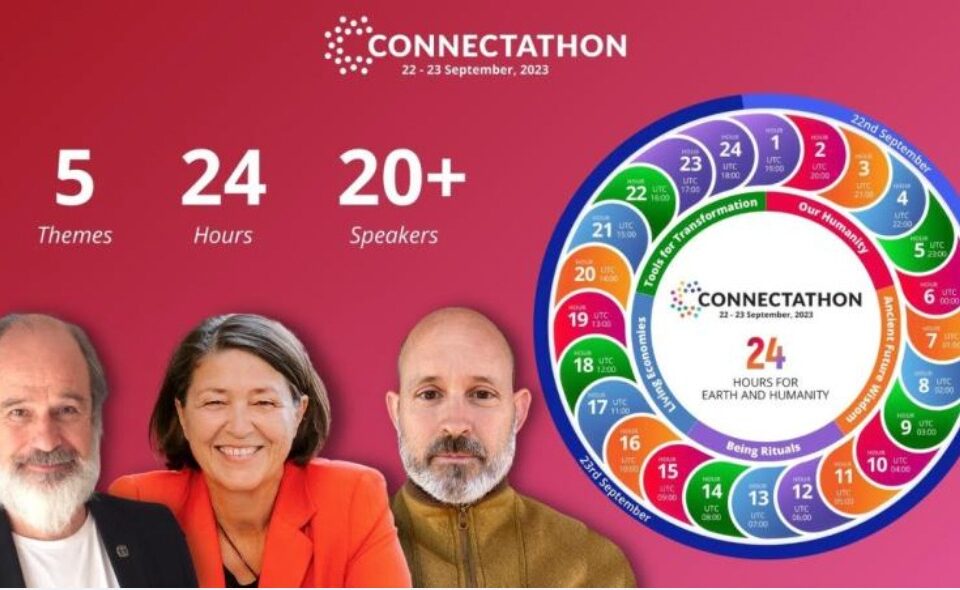
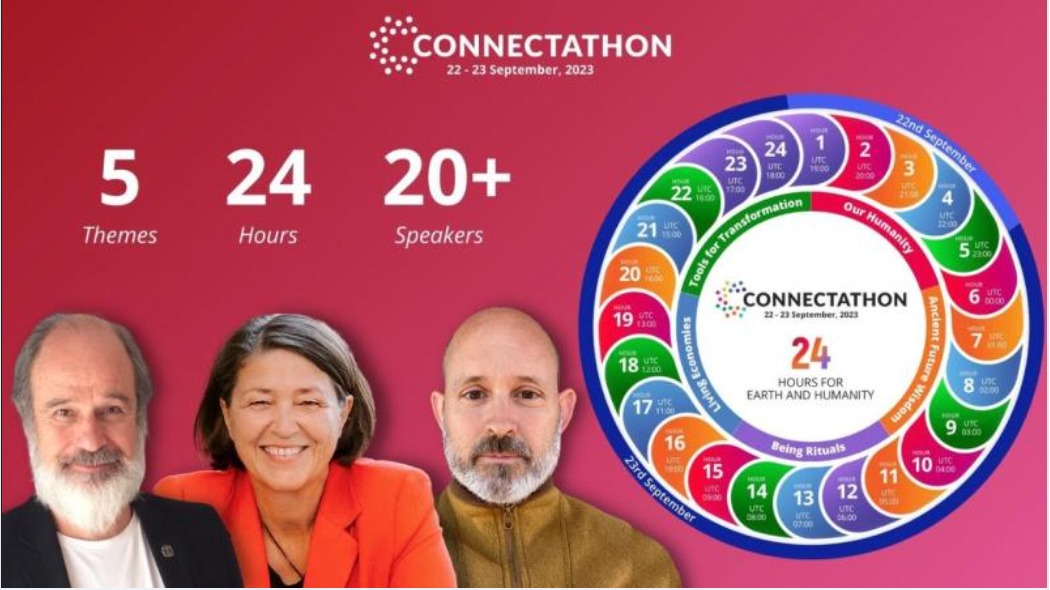
There are moments when something unfamiliar feels deeply known. Not learned but remembered. As if beneath the layers of roles, expectations, and accumulated noise, there has always been a quieter knowing, waiting to resurface. The Connectathon gathering unfolded in that space. A space where people did not come to become something new, but to re-member what has never truly been lost, just patiently waiting to be re-discovered.
The Connectathon began simply, gently, with music and storytelling about the past gatherings, supported with a strong intention, followed by a shared agreement, almost unspoken, to lead Connectathon with an open heart. Not as a metaphor, but as a practical orientation. The mind was present, sharp, capable, but it was invited to take its lead from something deeper. The heart and the subtle intelligence of the soul. In that alignment, head, heart, and soul, a different quality of actions emerged. Not forced, not optimized, but coherent.
There was a recognition that sustainability, as a concept, is no longer enough. To sustain implies maintaining what is. But what if what is, is not yet fully alive? The shift toward thrivability opened a new direction, toward generating life, not merely preserving it. Toward creating a positive handprint, where each action leaves behind conditions that enhance the future rather than merely reduce harm. It adds value not just seek zero negative effect. This is a quiet but radical reorientation: from minimizing damage to maximizing potential. And I could feel this reorientation at Connectathon.
In this space, the future felt as something already present. Someone described it as “memories of things yet to come,” echoing the sensibilities of Julio Cortázar or Jorge Luis Borges, where time folds, and the future calls us as much as the past shapes us. We did not attempt to predict or control what lies ahead. Instead, we practiced listening to it and the vibration will continue to stay with us, manifesting different results all over the world. Yet quietly being connected in this invisible quantum field of possibilities that we have collectively created.
Listening became the central act of Connectathon. Not listening to respond, fix, or interpret, but listening to receive. A form of compassionate listening where each person is not only heard but genuinely met. It required presence. It required trust. And perhaps most of all, it required a willingness to celebrate one another, not as a performance, but as a recognition of shared humanity.
“Remember your humanity,” one voice offered, expanding mutual acknowledgement towards remembering our own divinity. Both pointed to the same essence, a deeper identity beyond fragmentation. In that recognition, connection became the most natural state. That we were all part of.
So, the intelligence of the group was no longer about individuals contributing ideas, but about something emerging between us, so called relational intelligence. The familiar phrase, “No one of us is as smart as all of us”, came alive not as a slogan, but as lived experience. The Connectathon functioned as a collective organism, sensing, adapting, and creating in ways no single individual could orchestrate.
This echoes the work of thinkers like Alexander, who describe systems not as static structures, but as evolving fields of relationship. Here, that field was tangible. It could be felt in the pauses, in the silences, in the moments when no one spoke, yet something profound was happening.
There was no traditional leadership in the event. Or perhaps more accurately, leadership took on a different shape what could be described as coherence-holding. Interesting enough, that was also the essence of one of the debates organised by the Ecocivilisation Movement, discussing new roles and ways of self-organising and co-existing. It is worth saying that Connectathon itself is a great example of leadership without a leader in classical sense. Certain individuals helped maintain the integrity of the space, not by directing it, but by staying deeply attuned to it. Among them, figures like Stella, Roopin, and Kim were not leading in the conventional sense. They were anchoring presence.
“Kim is the kick. Kim is love,” someone said, half playfully, half in recognition of something real. It pointed to an energy that moves a group, not through authority, but through authenticity.
Trust became the underlying infrastructure of the Connectathon. Not blind trust, but an embodied confidence in oneself and in the collective process. “We trusted ourselves to deliver,” Suzie reflected, acknowledging that while there was no rigid plan, there was a strong intention at the beginning. That intention acted like a magnetic field, aligning energy and opening channels through which ideas, insights, and actions could flow.
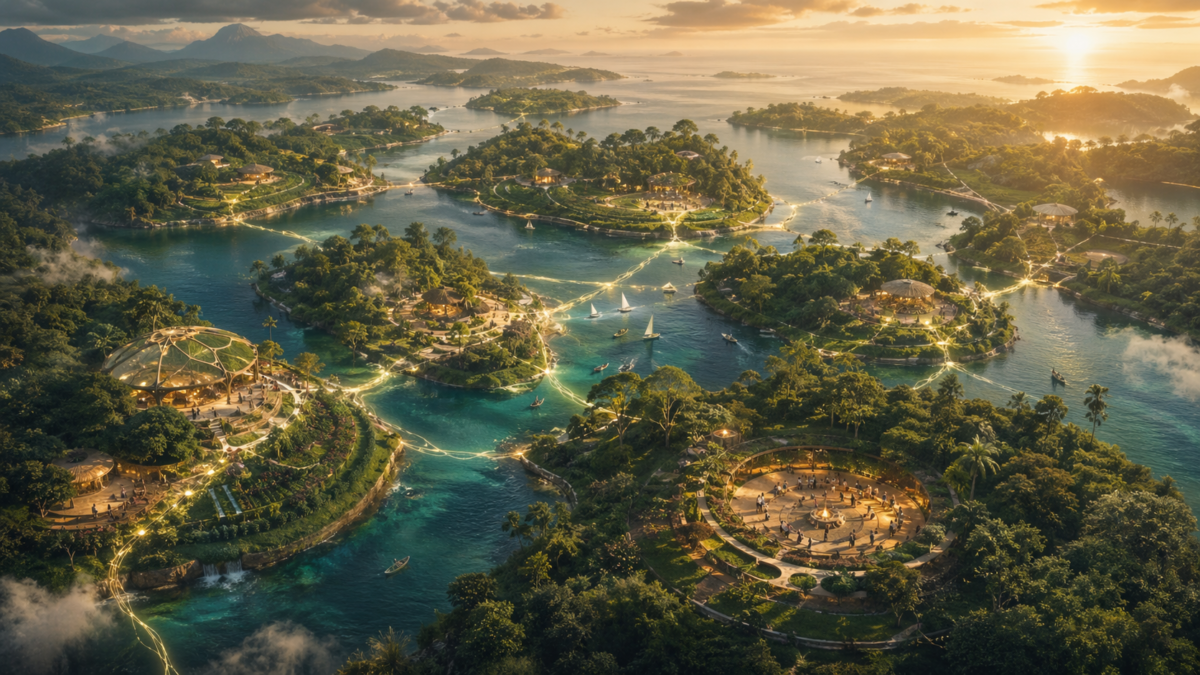
It is here that the idea of “islands of coherence”, as described by Ilya Prigogine, and expended in one of the sessions by the “ecosystems of coherence”, became almost tangible. Small pockets where order, meaning, and alignment arise within a wider field of uncertainty. These ecosystems are not imposed; they emerge when conditions allow. And perhaps most importantly, they connect.
Because, as John Donne wrote centuries ago, “No man is an island.” What appears as separate is, in truth, deeply interwoven. The coherence of one space resonates outward, touching others, shaping the larger whole. That is how I experienced the individual sessions, standing with unique messages yet deeply connected in the invisible field of rightness.
And then, something lighter emerged. A sense of play.
It was described as a secret playground, a return to child-like curiosity and creativity. Not childishness, but a kind of innocent engagement with life, free from the weight of constant seriousness. In that playfulness, barriers dissolve. Creativity expands. Possibilities multiply.
And from playfulness straight to a clear proposition by Suzie to slow down. Because by slowing down, we noticed more. To feel more. To align more precisely with what was happening, we entered the rhythm of now. And that was strongly present in the space of Connectathon.
In that rhythm, coherence extended beyond the human group. There was an awareness of the wider system, nature, unseen dynamics, even what some referred to as “cosmo-stories of the future yet to come.”
This awareness brought a quiet responsibility: to maintain coherence between human life and the larger whole. Not as an obligation imposed from outside, but as a natural consequence of feeling connected.
Throughout the experience, there was a recurring sense that nothing entirely new was being created. Rather, something ancient and essential was being remembered together. A remembering of who we are, of how we belong to ourselves, to each other, and to life.
The African concept of Kasala surfaced as a poetic expression of this. A form of collective honouring, where each person is seen, named, and celebrated within the web of relationships. “We are all Kasala,” someone said. Not as a statement, but as a deeply felt manifestation of the moment.
In the end, it is hard to talk about conclusions or outcomes, but I would express it as a felt experience. A subtle yet undeniable shift. It is clear as Alexander said it, “we are the ones we have been waiting for, but we are waiting no more”. We are sensing. We are listening. We are feeling that when we slow down, when we are fully present, trust ourselves, and meet each other with open hearts, something larger begins to move through us, clearing the path ahead, helping us to walk.
And perhaps that is the essence of thrivability. Not something we build. But something we allow to emerge.
This awareness brought a quiet responsibility: to maintain coherence between human life and the larger whole. Not as an obligation imposed from outside, but as a natural consequence of feeling connected.
Violeta Bulc